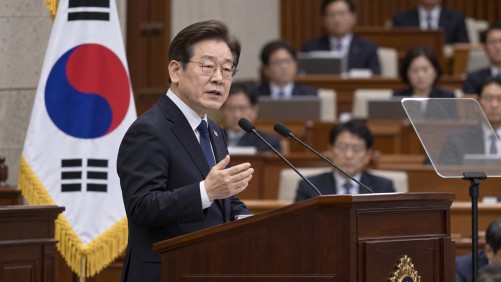
South Korean President Lee Jae Myung has called for constitutional amendments to formally recognize the nation’s historic pro-democracy movements, urging the National Assembly to initiate discussions on reform. This proposal was made during a ceremony in Busan commemorating the 47th anniversary of the 1979 Buma uprising, a crucial event in South Korea’s democratic evolution.
The Buma uprising, which began on October 16, 1979, saw students and citizens in Busan and Masan protest against the authoritarian regime of then-President Park Chung-hee. The uprising is viewed as a significant milestone in the country’s shift towards democracy, marked by arrests, martial law, and military actions against demonstrators.
President Lee emphasized the importance of embedding the Buma uprising and the May 1980 Gwangju Democratization Movement into the Constitution’s preamble. He argued that such recognition would honor those who bravely opposed authoritarian rule and preserve their legacy for future generations. Lee underscored the role of these movements in reinforcing the principle that political power must remain accountable to the people.
In addition to acknowledging past movements, Lee highlighted the significance of more recent democratic demonstrations, including the June 1987 Democracy Movement. He advocated for lawmakers from both ruling and opposition parties to engage in public consultations to pursue meaningful constitutional reform, ensuring that future generations do not face the same sacrifices to protect democracy.
Lee has consistently supported revising South Korea’s Constitution, which was last amended in 1987. His broader reform agenda includes changing the current single five-year presidential term to allow two consecutive four-year terms. A previous constitutional amendment proposed by the ruling Democratic Party of Korea failed to pass in the National Assembly in May. However, Lee believes that recognizing the country’s democratic movements could provide common ground for renewed discussions.
By promoting constitutional recognition of these pivotal movements, President Lee aims to safeguard their historical legacy and reinforce democratic principles in South Korea. The initiative reflects a commitment to ensuring that the spirit of democracy remains a cornerstone of the nation’s governance.