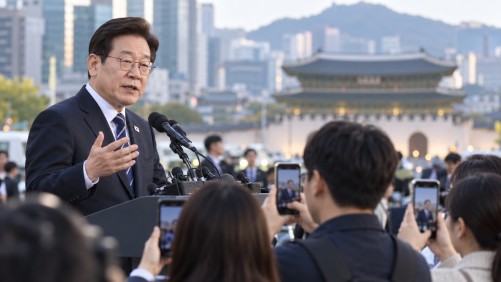
As political tensions rise in South Korea, President Lee Jae Myung has turned to social media to bridge the gap with the public amid a decline in his approval ratings. A recent national poll revealed that Lee’s approval rating has dipped by 2.2 percentage points to 35.2%, while disapproval has climbed to 61.4%. The survey highlighted waning support across centrist, conservative, and progressive voters, pointing to growing dissatisfaction with government policies and ongoing political disagreements.
Criticism directed at President Lee has focused on several areas, including personnel appointments, maintaining judicial independence, national security issues, and escalating housing costs in the Seoul metropolitan area. Additionally, disputes over prosecution reform have caused friction within the ruling Democratic Party of Korea. This internal strife has been mirrored in public sentiment, as the party experienced a sharp seven-point drop in support, reaching 35.5% in a separate poll. Conversely, the main opposition, the People Power Party, saw an increase to 41.3%, although this shift remains within the margin of error.
In response to these challenges, President Lee has ramped up his activity on the social media platform X, using it as a tool to communicate government initiatives, tackle political controversies, and showcase the administration’s achievements. His social media output surged from 37 posts in August to 116 in September, and 65 more posts in October. Lee has also committed to enhancing public engagement through press conferences, debates, field visits, and livestreams.
However, this increase in social media presence has not been without controversy. Some of Lee’s online remarks and personnel choices have sparked criticism, including disputes with supporters over prosecution reform. Opposition leaders have questioned the efficacy of his social media strategy, suggesting it may primarily engage political allies rather than address broader public concerns.
The debate over President Lee’s approach comes at a critical juncture as he seeks to regain public trust amid ongoing disputes over economic policy, national security, and judicial independence. As Lee continues to navigate these complex issues, his ability to connect with South Korea’s diverse electorate remains a focal point of his presidency.