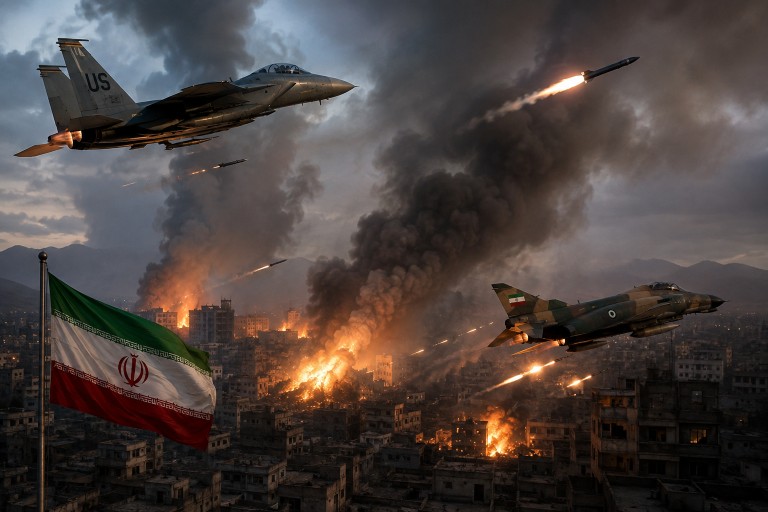
Recent airstrikes exchanged between the United States and Iran have intensified fears that the situation could escalate into broader conflict across the Middle East. The US military launched strikes aimed at facilities associated with Iran’s Islamic Revolutionary Guard Corps (IRGC), citing these actions as a response to Iran’s attempts to disrupt commercial shipping in the strategic Strait of Hormuz, alongside threats directed at American personnel stationed in the region.
In retaliation, Iran executed missile and drone assaults targeting American interests in multiple countries, including Jordan, Bahrain, Kuwait, and Iraq. Jordan’s military reported intercepting ten ballistic missiles fired from Iran, with three additional missiles landing in uninhabited areas. Fortunately, there were no immediate confirmations of casualties or damage at the US military training facility in Jordan.
Iran further alleged strikes against a US base near Erbil in Iraq, while missile and drone activities were also observed in Kuwait, and air-raid alarms were triggered in Bahrain. The heightened conflict has brought renewed attention to the security of the Strait of Hormuz, a vital conduit for global oil shipments, with oil prices already experiencing an uptick amid the tensions. Iran has issued a warning regarding its capacity to impede oil exports from the Gulf should the US ramp up military or economic pressures.
Iranian officials have condemned the latest US attacks, with President Masoud Pezeshkian asserting Tehran’s readiness to respond in kind if the US reneges on commitments made under a previous agreement aimed at de-escalating hostilities. Despite this, the situation remains tense, with both nations cautioning that further aggression could provoke stronger retaliation.
US President Donald Trump has indicated a potential for a more forceful American response should Iran proceed with additional assaults. Meanwhile, Iranian officials have emphasized their intention to employ both military and diplomatic strategies to safeguard their national interests. This resurgence of military confrontation follows a period where the conflict had largely shifted towards economic sanctions and blockades, raising concerns that the fragile efforts to manage the situation through non-military means might unravel, potentially leading the region into prolonged military engagement once again.