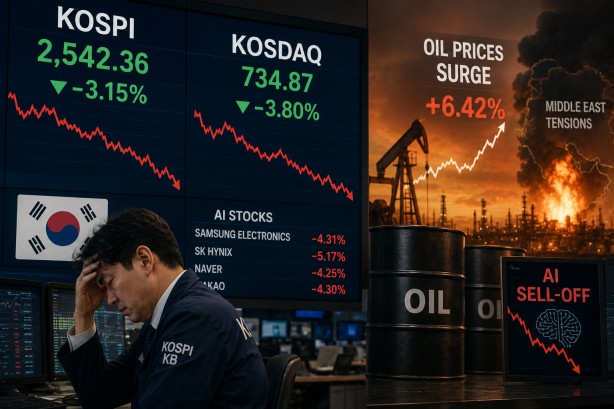
Monday saw a mixed performance in Asian markets, with notable movements in South Korea’s Kospi index, which plummeted nearly 5% as investors pulled back from artificial intelligence stocks due to increasing concerns over their valuations. The sell-off in South Korea’s technology sector was particularly acute, as major companies like Samsung Electronics and SK Hynix experienced significant declines of 4.4% and 3.3%, respectively.
Amid these developments in the stock markets, oil prices experienced a sharp uptick. Brent crude surged by 2.6% to reach $90.40 per barrel, while U.S. crude rose 2.2% to $83.58 per barrel. These gains were largely driven by heightened tensions between the United States and Iran, which have exacerbated fears of disruptions in the Middle East. As a result, the crucial Strait of Hormuz, a key passage for global energy exports, saw a noticeable slowdown in tanker traffic, further fueling concerns over global oil supplies.
Elsewhere in the region, Taiwan’s stock market remained relatively stable, with Taiwan Semiconductor Manufacturing Co. managing a 2% gain. Hong Kong’s Hang Seng index rose by 2.1%, while China’s Shanghai Composite increased by 1.2%. Additionally, Australia’s benchmark index experienced a slight increase, contrasting with India’s Sensex, which dipped by 0.9%.
Globally, technology stocks continue to face pressure as investors reassess the sustainability of the massive investments in artificial intelligence, fearing a potential market bubble. This cautious sentiment was compounded by the recent introduction of Kimi K3, a new open-source AI model from Beijing-based Moonshot AI, which has intensified competition within the dynamic sector.
These global market shifts followed a negative close on Wall Street the previous week, with the S&P 500, Dow Jones Industrial Average, and Nasdaq all ending in the red. Semiconductor stocks bore the brunt of the downturn, with companies such as Nvidia, Broadcom, and AMD registering declines.