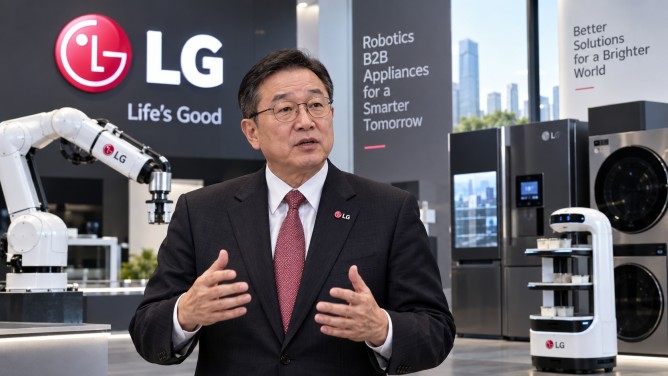
LG Electronics is setting its sights on robotic actuators and business-to-business appliances as promising sectors for future expansion. The South Korean firm is gearing up to meet potential large-scale demands from top-tier global tech companies. LG has engineered actuators that boast reduced weight, enhanced efficiency, and competitive pricing, with plans in place for mass production. Currently engaged in discussions with several prominent technology firms, LG anticipates finalizing its first significant order in the near future.
Earlier this year, LG introduced the LG Axium actuator brand, leveraging the company’s extensive expertise in motors, drive controls, and component design honed through its home appliance division. By the year’s end, LG aims to establish a fully automated actuator production line at its facility in Changwon. The company predicts that the demand for actuators will rise in conjunction with advancements in physical AI and humanoid robotics, particularly as we approach 2030. In line with this, LG plans to implement humanoid robots at its Tennessee plant and Changwon smart factory, with future ambitions to integrate these robots into household settings as safety technology continues to evolve.
Parallel to its actuator ambitions, LG is also broadening its B2B appliance segment. Notably, its built-in appliance and commercial laundry divisions have achieved annual revenue growth exceeding 40% over the past three years. In Europe, LG is bolstering its specialized sales team and expanding its premium built-in brands, with a target to increase product displays across 3,000 outlets by the end of the year.
Furthermore, LG is reinforcing its presence in the commercial laundry sector by introducing machines with larger capacities and fostering partnerships within Southeast Asia. In the European market, LG is advocating for high-efficiency appliances as part of its strategy to emerge as a leading home appliance entity in the region by 2030.