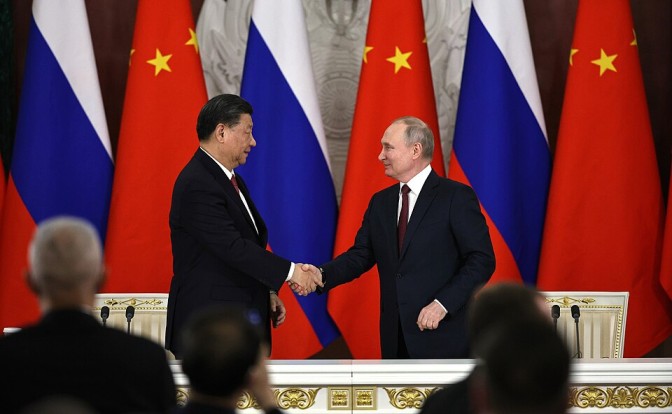
In a significant diplomatic development, Chinese President Xi Jinping and Russian President Vladimir Putin have agreed to extend the China-Russia Treaty of Good-Neighborliness and Friendly Cooperation. This decision, announced after their meeting at Beijing’s Great Hall of the People, underscores their commitment to enhancing political trust, strategic coordination, and cooperation between the two nations amid a volatile global landscape. The discussions marked the conclusion of Putin’s two-day state visit to China, during which both leaders signed a joint statement to further solidify their comprehensive strategic partnership and witnessed the signing of 20 cooperation agreements spanning sectors such as trade, education, and technology.
The landmark meeting comes at a pivotal moment, as this year commemorates the 30th anniversary of the China-Russia strategic partnership and the 25th anniversary of the treaty itself. President Xi highlighted the historical significance of these milestones, noting that bilateral ties have reached unprecedented heights over the past three decades. The treaty, last extended in 2021, is rooted in principles of non-alliance, non-confrontation, and non-targeting of third parties, which both countries have upheld to foster mutual respect and cooperation.
Economic collaboration has been a focal point of China-Russia relations, with bilateral trade surpassing $200 billion annually for three consecutive years. In the first four months of 2026 alone, trade between the two countries increased by nearly 20 percent. President Xi emphasized the need to build on this momentum by aligning China’s 15th Five-Year Plan with Russia’s 2030 development strategy, aiming to enhance cooperation across various fields for mutual benefit. Both leaders also addressed global governance, stressing the importance of upholding international law and countering unilateralism and hegemonism.
President Putin echoed Xi’s sentiments, describing their relationship as unprecedented and resilient to the changing international environment. He expressed confidence in the future of their partnership, emphasizing the importance of strengthening people-to-people bonds and contributing to both nations’ development. Both leaders affirmed their commitment to upholding international law within frameworks like the Shanghai Cooperation Organization and BRICS, aiming to address global and regional challenges collaboratively.
Amid their robust diplomatic exchanges, China announced an extension of its visa-free policy for Russian citizens until the end of 2027, reciprocated by Russia for Chinese citizens. The leaders also discussed pressing international issues, including the Middle East conflict, with President Xi advocating for an immediate cessation of hostilities to stabilize energy supplies and trade. The state visit was capped off with a welcoming banquet hosted by Xi for Putin, symbolizing the continued camaraderie between the two nations.